
In Quebec, every season brings its own set of gear
Winter is quickly taking over our roads… but also our closets. Coats, boots, hats, and mittens are reappearing in the entryway. Skis, snowboards, and other winter gear are being hauled out of the basement or garage. For a single person, that’s already a lot of stuff. For an entire family, the amount of space needed can be staggering.
In fact, all it takes is hosting family and friends during the holidays to realize just how much space winter demands of us. We’ve all seen that famous bed that disappears under a mountain of coats during the Christmas party. Now multiply the coats, boots, and accessories by every member of the family… and imagine how much space they take up the rest of the year.
Then spring arrives. Coats gradually disappear, but they’re replaced by bicycles, camping gear, fishing equipment, outdoor furniture, and everything else that comes with the return of warm weather.
Our storage needs change almost as much as the seasons do. Yet our homes generally have to accommodate all four at the same time.
How does seasonal storage work?
Most of our seasonal items have one thing in common: they can be essential for a few months and then become completely useless for the rest of the year.
A snowboard doesn’t necessarily need to take up space in your storage area in July, any more than your fishing or camping gear does doesn’t need to be easily accessible in January. However, when you keep everything at home, gear for all four seasons often ends up sharing the same closets, garage, or storage space.
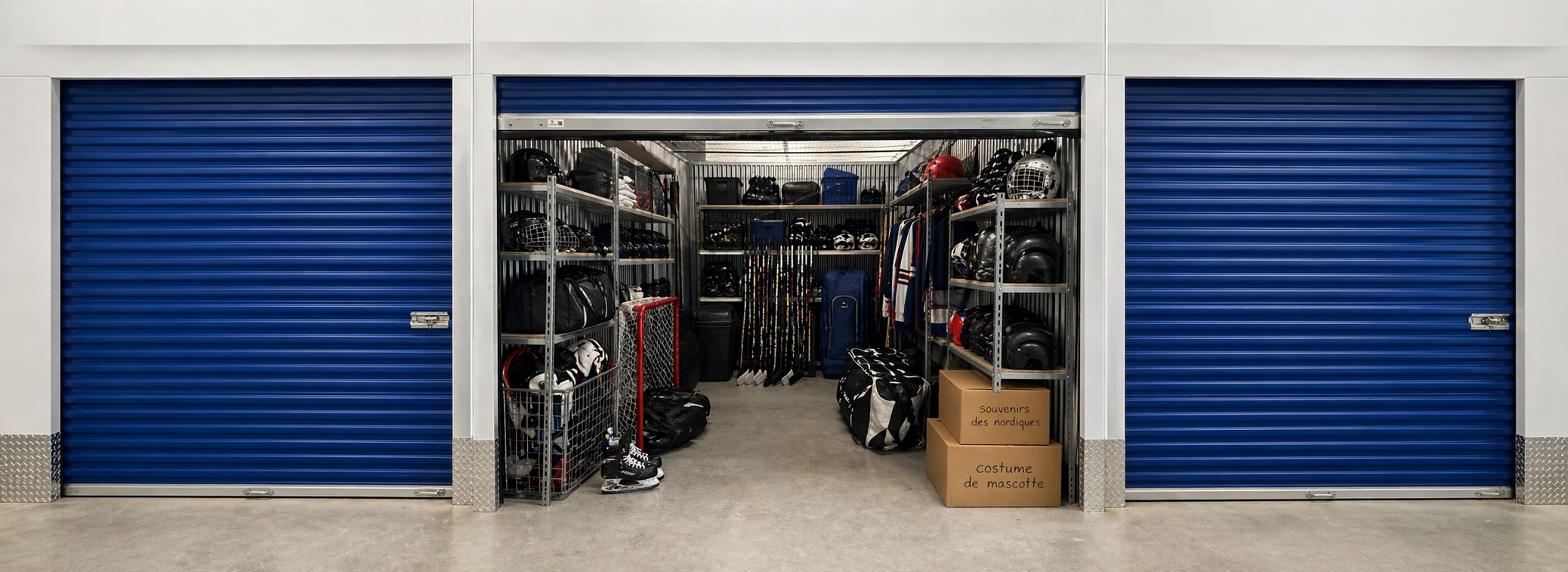
The mini-storage unit can then serve as a sort of seasonal closet for the home. Instead of constantly trying to figure out how to make room for all your gear, you can keep what’s appropriate for the current season at home and temporarily store the rest.
In the spring and fall, all you need to do is gradually reverse the rotation.
What Should You Put Away in the Spring?
After several months of cold weather, spring usually marks the return of many things we had almost forgotten.
Depending on your activities, it's time to bring out:
- Bicycles;
- Camping gear;
- Fishing gear;
- Kayaks and other outdoor gear;
- Outdoor furniture;
- Summer sports equipment.
In exchange, some of your winter gear can be stored elsewhere. Skis, snowboards, snowshoes, and certain winter clothes no longer need to take up the most accessible storage space for several months.
This rotation is particularly useful when several people live under the same roof. Just a few items per family member are enough to quickly fill a section of the basement or garage.
What Should You Put Away in the Fall?
When temperatures start to drop, the rotation reverses.
Outdoor furniture is put away, camping gear becomes less useful, and bicycles are gradually giving way to winter activities. Warmer coats, boots, skis, and snowboards are quietly becoming part of everyday life again.
This is also the time of year when many Quebecers change their tires. Four tires already take up quite a bit of space. If a family has two vehicles, that’s eight tires that need to be stored somewhere for several months.
A storage unit allows you to move some of these seasonal items out of the house and free up space for the things you’ll actually use during the winter.
Where should you store your sports and outdoor equipment?
The activities we enjoy also require space.
Someone who enjoys fishing and camping can end up with a lot of boots, clothing, fishing rods, bags, and other gear needed for these outings. Add a winter hobby like skiing or snowboarding, and that same storage space suddenly has to accommodate two sets of bulky gear that will almost never be used at the same time.
The problem isn't that we own useless things. On the contrary, we sometimes run out of space precisely because we own things we enjoy using.
Seasonal storage allows you to keep this equipment without necessarily having to set aside valuable square footage at home for it all year round. When the season comes around again, you can retrieve what you need and enjoy it once more.
How should you prepare your equipment before storing it?
Before putting your equipment away for several months, take a few minutes to prepare it. Cleaning and drying your gear properly before storing it will help ensure that you don’t find it damp or dirty in the spring after it has been left in that condition for several months.
Also, be sure to check the contents of your belongings. Certain items and products are prohibited in Mon Sspace units, including flammable, explosive, or hazardous substances, batteries, and certain chemicals. Food items that may attract pests may not be stored there either.
A tent, outdoor furniture, or various outdoor gear can therefore be stored here, while certain accompanying products or accessories will need to be stored elsewhere.
Take advantage of the change of seasons to declutter
The advantage of seasonal storage is that it also gives you a chance to regularly review what you own. When you return to your storage unit in the spring or fall, you can take advantage of the change in season to check what you actually use.
Some items will come back home every year. Others may have become too small for the children, been replaced, or simply no longer fit the family’s needs.
Rotation thus becomes as much a way to organize one's space as it is an opportunity to prevent clutter from building up over the years.
Four seasons, one living space
Living in Quebec means constantly adapting our habits to the season. The way we dress changes, our activities evolve, and the items we need change with the seasons. Unfortunately, our home doesn’t get any bigger when winter arrives.
Located on Boulevard de l’Ormière in Quebec City, Mon Sspace offers units of various sizes that can serve as a seasonal extension of your living space. This allows you to keep the belongings you love and will need again, while freeing up space at home for the season you’re currently experiencing.
You can't "put away" a Quebec winter. But you can avoid having to store it in your closets twelve months a year.

